The Beauty Of Surah Al-Falaq | Nouman Ali Khan | Illustrated
Showing posts with label Stories for U n Me. Show all posts
Showing posts with label Stories for U n Me. Show all posts
Friday, July 5, 2013

Wednesday, April 10, 2013
My Eyptian Village 3
بسم الله الرحمان الرحيم
In the Name of Allah,
the Most Gracious, the Most Merciful.
4. Our River Nile
Al-Hamdulillah, the River Nile flows through our country. It is
the longest river in the world and for thousands of years has been
our life blood.

In the past, the Nile would flood each summer when the snows of
the Jibaal al- qamar (''mountains of the moon'') melted in the high-
lands of East Africa. Most years, flood waters brought a rich layer
of wet mud that irrigated and enriched the fields. In some regions,
four or five crops could be grown in one year!
In 1967, the Aswan High Dam project was completed. In the south
of Egypt, the Nile River was dammed for the first time creating the
world's largest reservoir -- Lake Nasser. Today, the Aswan High
Dam controls the flow of the Nile River. Flooding no longer occurs.
Fellahin all along its banks make use of the river water for their
farming.
In the picture, you can see a felucca, the traditional broad-sail boat
of the Nile. It belongs to my uncle who named it after my aunt :
Nuriyyah. When my uncle does not have to deliver goods up and
down the river, he lets us sail with him in his boat. In our part of
Egypt, there are no longer any crocodiles or hippopotamuses in
the river. The Nile crocodiles does live along the river banks in
the south. When the Greeks first came to our country more than
two thousand years ago, they had never seen a hippo before. As a
result, they called this large water-dwelling mammal a ''river horse''
or hippopotamus in Greek.
Each summer, my uncle takes me and my family on his felucca and
we spend the entire day sailing. This is where I learned to swim. I can
now dive very deep, too! The water here is cleaner and fish are found
in plenty. I swim a lot and catch a lot of fish in the clean water of the
river. Fish are indeed found in abundance if you know where to look
for them.
At the back of the felucca, my uncle has built a small musallah out of
wooden planks. We make wudhu using water from the Nile River, and
if possible pray all together in the musallah. At the end of the day, we
fry our day's catch of fresh fish which we eat with my mother's delicious
aysh. Al-Hamdulillah for Allah's many, many blessings!
5. Our Village Market
Every Thursday there is an open market - the suq al-khamees -- on the
outskirts of our village. The suq-al-khamees is an opportunity for all
of us to meet up with our friends from neighbouring villages. It is here
that I sometimes sell some extra eggs!
Everyone likes to visit the suq-al-khamees. The variety of goods for
sale is truly amazing. The freshest fruits and vegetables are piled into
high pyramids, but by the end of the day, these may be reduced to mere
handfuls.
In the corner of the market, animals are sold: donkeys, horses, goats,
sheep, water buffalo and camels. Our village lies on the camel caravan
route that begins in the Sudan and ends in the great camel market (suq
al-jamaal), in Imbaba, a suburb of Cairo.
For the children of our village, the most exciting time is when the
camel caravans pass through Al-Khayriyyah. Life in the desert is not
possible without the camel, the safinah al-sahara', or ''the ship of the
desert''. Whenever I see a camel, I remember the Prophet Muhammad
صلى الله عليه وسلم, who like everyone during his time, owned and rode
camels. I remember the story of the Prophetصلى الله عليه وسلم when he had
to migrate from Makkah -the event that initiated the hijrah calender. On
his entering Yathreb (Al-Madinah), all ansars (the people of Al-Madinah
who supported the Prophetصلى الله عليه وسلم) wanted the camel (named al-
qaswa') to come to rest in front of their house. The camel did stop at a
place which is today the site of the Prophetصلى الله عليه وسلم's Masjid in
Al-Madinah. 'Abu Ayyub al-Ansariرضى الله عنه, because his house was
closest to where the camel stopped, became the first Companion to
offer the Prophetصلى الله عليه وسلم a place to rest in Al-Madinah.

Years ago, the black (or occasionally green) Kiswah, or covering for
the Kaa'bah in Makkah was made in Egypt (see illustration). Each year
the newly embroidered kiswah was transported by camel to Makkah in
a ceremony called the mahmal. My grandfather remembers a story his
father told him : a camel from Al-khayriyyah village was once chosen
to carry the kiswah to Makkah. This was indeed an honour our village
has never forgotten.
Sitting atop a camel and riding among the sand dunes behind our village,
I often imagine myself a famous traveller like Ibn Battuta. But sometimes,
the up and down swaying motion makes me feel ''sea sick'', as if I were
really sailing on a ''ship in the desert''!
Islamic Village Stories
Written & Illustrated by
Luqman Nagy
In the Name of Allah,
the Most Gracious, the Most Merciful.
4. Our River Nile
Al-Hamdulillah, the River Nile flows through our country. It is
the longest river in the world and for thousands of years has been
our life blood.

In the past, the Nile would flood each summer when the snows of
the Jibaal al- qamar (''mountains of the moon'') melted in the high-
lands of East Africa. Most years, flood waters brought a rich layer
of wet mud that irrigated and enriched the fields. In some regions,
four or five crops could be grown in one year!
In 1967, the Aswan High Dam project was completed. In the south
of Egypt, the Nile River was dammed for the first time creating the
world's largest reservoir -- Lake Nasser. Today, the Aswan High
Dam controls the flow of the Nile River. Flooding no longer occurs.
Fellahin all along its banks make use of the river water for their
farming.
In the picture, you can see a felucca, the traditional broad-sail boat
of the Nile. It belongs to my uncle who named it after my aunt :
Nuriyyah. When my uncle does not have to deliver goods up and
down the river, he lets us sail with him in his boat. In our part of
Egypt, there are no longer any crocodiles or hippopotamuses in
the river. The Nile crocodiles does live along the river banks in
the south. When the Greeks first came to our country more than
two thousand years ago, they had never seen a hippo before. As a
result, they called this large water-dwelling mammal a ''river horse''
or hippopotamus in Greek.
Each summer, my uncle takes me and my family on his felucca and
we spend the entire day sailing. This is where I learned to swim. I can
now dive very deep, too! The water here is cleaner and fish are found
in plenty. I swim a lot and catch a lot of fish in the clean water of the
river. Fish are indeed found in abundance if you know where to look
for them.
At the back of the felucca, my uncle has built a small musallah out of
wooden planks. We make wudhu using water from the Nile River, and
if possible pray all together in the musallah. At the end of the day, we
fry our day's catch of fresh fish which we eat with my mother's delicious
aysh. Al-Hamdulillah for Allah's many, many blessings!
5. Our Village Market
Every Thursday there is an open market - the suq al-khamees -- on the
outskirts of our village. The suq-al-khamees is an opportunity for all
of us to meet up with our friends from neighbouring villages. It is here
that I sometimes sell some extra eggs!
Everyone likes to visit the suq-al-khamees. The variety of goods for
sale is truly amazing. The freshest fruits and vegetables are piled into
high pyramids, but by the end of the day, these may be reduced to mere
handfuls.
In the corner of the market, animals are sold: donkeys, horses, goats,
sheep, water buffalo and camels. Our village lies on the camel caravan
route that begins in the Sudan and ends in the great camel market (suq
al-jamaal), in Imbaba, a suburb of Cairo.
For the children of our village, the most exciting time is when the
camel caravans pass through Al-Khayriyyah. Life in the desert is not
possible without the camel, the safinah al-sahara', or ''the ship of the
desert''. Whenever I see a camel, I remember the Prophet Muhammad
صلى الله عليه وسلم, who like everyone during his time, owned and rode
camels. I remember the story of the Prophetصلى الله عليه وسلم when he had
to migrate from Makkah -the event that initiated the hijrah calender. On
his entering Yathreb (Al-Madinah), all ansars (the people of Al-Madinah
who supported the Prophetصلى الله عليه وسلم) wanted the camel (named al-
qaswa') to come to rest in front of their house. The camel did stop at a
place which is today the site of the Prophetصلى الله عليه وسلم's Masjid in
Al-Madinah. 'Abu Ayyub al-Ansariرضى الله عنه, because his house was
closest to where the camel stopped, became the first Companion to
offer the Prophetصلى الله عليه وسلم a place to rest in Al-Madinah.

Years ago, the black (or occasionally green) Kiswah, or covering for
the Kaa'bah in Makkah was made in Egypt (see illustration). Each year
the newly embroidered kiswah was transported by camel to Makkah in
a ceremony called the mahmal. My grandfather remembers a story his
father told him : a camel from Al-khayriyyah village was once chosen
to carry the kiswah to Makkah. This was indeed an honour our village
has never forgotten.
Sitting atop a camel and riding among the sand dunes behind our village,
I often imagine myself a famous traveller like Ibn Battuta. But sometimes,
the up and down swaying motion makes me feel ''sea sick'', as if I were
really sailing on a ''ship in the desert''!
Islamic Village Stories
Written & Illustrated by
Luqman Nagy
Tuesday, February 12, 2013
The story of a boy and a tree
A long time ago, there was a huge apple tree.
A little boy loved to come and play around it everyday.
He climbed to the treetop, ate the apples, took a nap under the shadow...
he loved the tree and the tree loved to play with him.
Time went by...the little boy had grown up and he no longer
played around the tree every day...........
Friday, January 18, 2013
My Egyptian Village (2)
بسم الله الرحمان الرحيم
In the Name of Allah,
the Most Gracious, the Most merciful.
2. My Mud House

Here is my mud house. I was born
here twelve years ago. We still
build our houses using the local
earth mixed with straw. A few
villages have tried using more
modern building materials like
concrete and tin roofing but their
houses are not as comfortable
to live in as ours. Our houses are
cool during the hot summer
months and cozy in the winter
evenings.
A famous Egyptian architect, Hassan Fathy from Cairo, our capital city,
once visited our village. With him was a group of young university students
of architecture. They took photographs of our house and asked my father
many questions about its construction. Hassan Fathy was not a villager,
but he understood the importance of traditional earth building techniques-
and of keeping this technique alive.Today, his students encourage people
to use earth as a building material. Hassan Fathy told us that the design of
our village houses was very ancient. For example, in front of our house,
is a long baked mud-bench called a mastaba in Arabic. This was a feature
of all ancient Egyptian houses. Today, we of course are Muslims,
al-Hamdulillah. The days of the pharaohs are buried in the past. We can
no longer even imagine worshipping any god other than Allah,
Rabb al-'Ameen, the True Deity who sent to us His final Messenger,
the Prophet Muhammad صلى الله عليه وسلم, as a mercy to all nations.
It has been the custom in our village to work very hard and save money
so that one day we might be able to visit the Holy Cities of Makkah and
Madinah. Al-Hamdulillah, my father and mother made their Hajj, or
pilgrimage, two years ago. Our house is now known as a ''hajj house''.
'Abd al- Rahman, a village artist, is always busy whenever anyone returns
from the hajj. My father hired him to paint colourful scenes on the outside
of our house. In Al-Khayriyyah village, there are several houses like ours.
I actually helped 'Abd al-Rahman paint some of the pictures; for example,
I painted the kiswah, or black covering over the kaa'bah and the Egyptian
flag on the passenger ship.
Insha'Allah, one day we will all be able to visit Holy Makkah and perform
hajj and meet millions of fellow Muslims on the Plain of Arafat on that
glorious day, and offer our heartfelt prayers knowing that they will all be
accepted.
3. Our Food
 In Arabic, we are known as fellahin
or ''people of the countryside''. Our
life is hard but beautiful, and we
always offer thanks to Allah.
Our day begins with the Adhan, or
call to morning prayer, but quite
often it is our rooster that wakes us
up! Our masjid is in the middle of
Al-Khayriyyah so that everyone can
easily come for prayer. After salat
al-fajr, we always read from the
Holy Qur'an. Before starting our day,
reading from kitab Allah strengthens
our imaan and our desire to be good
servants of Allah.
We all have chores to do immediately after prayers. The water buffalo need
to be milked and their milk is to be quickly transported to the city for sale.
I collect the eggs our chickens have laid and sometimes sell them in the
week-end market. My mother and sisters prepare for us a hearty breakfast.
Our breakfast table is full of delicious and nutritious food, Masha'Allah.
The staple food of all fellahin is aysh, a wonderful coarse whole wheat flat
bread and ful medammes, stewed brown fava beans with salt and lemon juice.
We also have some white goat's cheese and gigantic fresh radishes. This
morning, my mother has prepared a very special Egyptian drink - karkadi
or hibiscus tea. This is a delicious bright red drink made from the dried petal-
like parts of the karkadi plant. In Ramadhan, we very often break our fast with
a refreshing glass of hibiscus tea which can be drunk hot or cold.
The dark green soup you see on the table is another Egyptian favourite -
melokhiyah. This is a very healthy vegetable, something like spinach.
It has been eaten in Egypt for thousands of years.
Egypt has always has its fellahin. Masha'Allah, we helped to build the
pyramids and other ancient monumental buildings without the use of
modern technology. We also supplied the food to the pyramid builders.
Our baladi or traditional home-cooked food keeps us strong and healthy,
al-Hamdulillah.
Islamic Village Stories
Written & Illustrated by
Luqman Nagy
In the Name of Allah,
the Most Gracious, the Most merciful.
2. My Mud House

Here is my mud house. I was born
here twelve years ago. We still
build our houses using the local
earth mixed with straw. A few
villages have tried using more
modern building materials like
concrete and tin roofing but their
houses are not as comfortable
to live in as ours. Our houses are
cool during the hot summer
months and cozy in the winter
evenings.
A famous Egyptian architect, Hassan Fathy from Cairo, our capital city,
once visited our village. With him was a group of young university students
of architecture. They took photographs of our house and asked my father
many questions about its construction. Hassan Fathy was not a villager,
but he understood the importance of traditional earth building techniques-
and of keeping this technique alive.Today, his students encourage people
to use earth as a building material. Hassan Fathy told us that the design of
our village houses was very ancient. For example, in front of our house,
is a long baked mud-bench called a mastaba in Arabic. This was a feature
of all ancient Egyptian houses. Today, we of course are Muslims,
al-Hamdulillah. The days of the pharaohs are buried in the past. We can
no longer even imagine worshipping any god other than Allah,
Rabb al-'Ameen, the True Deity who sent to us His final Messenger,
the Prophet Muhammad صلى الله عليه وسلم, as a mercy to all nations.
It has been the custom in our village to work very hard and save money
so that one day we might be able to visit the Holy Cities of Makkah and
Madinah. Al-Hamdulillah, my father and mother made their Hajj, or
pilgrimage, two years ago. Our house is now known as a ''hajj house''.
'Abd al- Rahman, a village artist, is always busy whenever anyone returns
from the hajj. My father hired him to paint colourful scenes on the outside
of our house. In Al-Khayriyyah village, there are several houses like ours.
I actually helped 'Abd al-Rahman paint some of the pictures; for example,
I painted the kiswah, or black covering over the kaa'bah and the Egyptian
flag on the passenger ship.
Insha'Allah, one day we will all be able to visit Holy Makkah and perform
hajj and meet millions of fellow Muslims on the Plain of Arafat on that
glorious day, and offer our heartfelt prayers knowing that they will all be
accepted.
3. Our Food

or ''people of the countryside''. Our
life is hard but beautiful, and we
always offer thanks to Allah.
Our day begins with the Adhan, or
call to morning prayer, but quite
often it is our rooster that wakes us
up! Our masjid is in the middle of
Al-Khayriyyah so that everyone can
easily come for prayer. After salat
al-fajr, we always read from the
Holy Qur'an. Before starting our day,
reading from kitab Allah strengthens
our imaan and our desire to be good
servants of Allah.
We all have chores to do immediately after prayers. The water buffalo need
to be milked and their milk is to be quickly transported to the city for sale.
I collect the eggs our chickens have laid and sometimes sell them in the
week-end market. My mother and sisters prepare for us a hearty breakfast.
Our breakfast table is full of delicious and nutritious food, Masha'Allah.
The staple food of all fellahin is aysh, a wonderful coarse whole wheat flat
bread and ful medammes, stewed brown fava beans with salt and lemon juice.
We also have some white goat's cheese and gigantic fresh radishes. This
morning, my mother has prepared a very special Egyptian drink - karkadi
or hibiscus tea. This is a delicious bright red drink made from the dried petal-
like parts of the karkadi plant. In Ramadhan, we very often break our fast with
a refreshing glass of hibiscus tea which can be drunk hot or cold.
The dark green soup you see on the table is another Egyptian favourite -
melokhiyah. This is a very healthy vegetable, something like spinach.
It has been eaten in Egypt for thousands of years.
Egypt has always has its fellahin. Masha'Allah, we helped to build the
pyramids and other ancient monumental buildings without the use of
modern technology. We also supplied the food to the pyramid builders.
Our baladi or traditional home-cooked food keeps us strong and healthy,
al-Hamdulillah.
Islamic Village Stories
Written & Illustrated by
Luqman Nagy
Tuesday, December 25, 2012
Smoke
بسم الله الرحمان الرحيم
In the Name of Allah,
the Most Gracious, the Most Merciful.

Once upon a time there was a man called Hatem.
He was a rich and generous man. He had many
herds of animals that grazed in the grassy fields,
and he loved to share his wealth with others.
Hatem had a pitch-black horse called Smoke.
Everybody admired this horse for its speed. It
ran like a flying eagle. Hatem regarded Smoke
as the apple of his eye, and he would not give it
up for anything.
Finally, the fame of Hatem's wealth and his
beautiful horse reached the ears of the Sultan.
When the Sultan heard about him he called his
Grand Vizier and said :
''I want to test Hatem's generosity. Ask him to
give me Smoke. Let's see what he does.''
The Sultan's men set off the next day. One night
when it was raining very hard they reached Hatem's
house and became his guests.
Hatem greeted them with joy and warmth. He ordered
his servants to prepare food for his guests. Soon an
excellent table was set for dinner and they all sat down
to eat. After the meal the guests were put up in very
comfortable beds, where they slept soundly.
The next morning when the guests explained why they
had come, Hatem became very sad and didn't know what
to do in his great sorrow.
''What a pity!'' he said, ''I wished you had told me what
the Sultan wanted as soon as you had arrived. I know
that you love horsemeat, and last night, as due to the
bad weather I couldn't find anything else to offer you.
So, I slaughtered Smoke last night for us to eat, as I had
no other alternative.''
But even Hatem's generosity paled next to our Prophetصلى الله عليه وسلم's,
who once gave a single man a gift of a hundred camels!
Our glorious Prophetصلى الله عليه وسلم stated in the following
hadith how great a character trait generosity was :
''A generous person is close to Allah,
close to human beings, close to Paradise,
and far from Hell.''
السَّخِىُّ قَرِيبٌ مِن اللَّهِ قَرِيبٌ مِن الجَنَّةِ
قَرِيبٌ مِن النَّاسِ بَعِيدٌ مِن النَّالرِ
رواه الترمذى
In the Name of Allah,
the Most Gracious, the Most Merciful.
Once upon a time there was a man called Hatem.
He was a rich and generous man. He had many
herds of animals that grazed in the grassy fields,
and he loved to share his wealth with others.
Hatem had a pitch-black horse called Smoke.
Everybody admired this horse for its speed. It
ran like a flying eagle. Hatem regarded Smoke
as the apple of his eye, and he would not give it
up for anything.
Finally, the fame of Hatem's wealth and his
beautiful horse reached the ears of the Sultan.
When the Sultan heard about him he called his
Grand Vizier and said :
''I want to test Hatem's generosity. Ask him to
give me Smoke. Let's see what he does.''
The Sultan's men set off the next day. One night
when it was raining very hard they reached Hatem's
house and became his guests.
Hatem greeted them with joy and warmth. He ordered
his servants to prepare food for his guests. Soon an
excellent table was set for dinner and they all sat down
to eat. After the meal the guests were put up in very
comfortable beds, where they slept soundly.
The next morning when the guests explained why they
had come, Hatem became very sad and didn't know what
to do in his great sorrow.
''What a pity!'' he said, ''I wished you had told me what
the Sultan wanted as soon as you had arrived. I know
that you love horsemeat, and last night, as due to the
bad weather I couldn't find anything else to offer you.
So, I slaughtered Smoke last night for us to eat, as I had
no other alternative.''
But even Hatem's generosity paled next to our Prophetصلى الله عليه وسلم's,
who once gave a single man a gift of a hundred camels!
Our glorious Prophetصلى الله عليه وسلم stated in the following
hadith how great a character trait generosity was :
''A generous person is close to Allah,
close to human beings, close to Paradise,
and far from Hell.''
السَّخِىُّ قَرِيبٌ مِن اللَّهِ قَرِيبٌ مِن الجَنَّةِ
قَرِيبٌ مِن النَّاسِ بَعِيدٌ مِن النَّالرِ
رواه الترمذى
Friday, November 2, 2012
My Egyptian Village
بسم الله الرحمان الرحيم
In the Name of Allah,
the Most Gracious, the Most Merciful.
Introduction

Egypt, also know as Misr in Arabic,
is quite unlike any other Muslim
country. For almost five thousand
years there has been an unbroken
historical record of people
inhabiting this land on
the banks of River Nile.
It is along this ribbon of blue,
amidst a bright yellow desert
landscape that the village of
Al-Khayriyyah is located.
This is the home of
'Abd al-Kareem, an extremely
gentle Egyptian boy who is
very keen to show you around
his village.
Since the time of the Companion of the Prophetصلى الله عليه وسلم
'Amr ibn al-'Asرضى الله عنه, Egypt has been a Muslim
Country. Important Islamic dynasties, such as the Tulinid, Fatimid,
Ayyubid, Mamluk and Ottaman, all once ruled this land. Kingdoms,
sultanates and empires rose and fell but the River Nile never ceased
flowing nor did the hard-working people of the countryside- Fellahin -
cease tilling the fertile fields along its banks.
Al-khayriyyah is a village of fellahin. Their lives have changed little
over the years which has helped them preserve many old Islamic
traditions and practices.
Now turn the page and let 'Abd al-Kareem introduce you to his
colourful Egyptian World.
To you all my Salaams.
Luqman Nagy
1. History of My Village

My name is 'Abd al-Kareem and
I am a Muslim, al-Hamdulillah.
I live in a beautiful Egyptian Village.
My village is called Al- Khayriyyah,
because the people who first lived
here were ''charitable'' - they always
offered aid or Khayr to those in need.
''Welcome to my village!'' or as we
say in Arabic, ''ahlan wa sahlan
wa marhaban fee baytee.''
As you can see, my village is not
far from the ancient step pyramid
of Zoser at Saqqara, the oldest of
all Egyptian pyramids. We live on the
banks of the deep and wide Nile River.
We read in our history books that my country was called the ''gift of the Nile''
by the ancient Greeks. Egypt is a desert country, but al-Hamdulillah,
because of the Nile River, farmers for thousands of years have been
able to grow wheat and other crops to support its population.
My father owns a herd of water buffalo (or gamoosa in Arabic). These
animals resemble big horned cows. They love to eat all the wonderful
fresh green grass that grows in the fields near our village. As a result,
water buffalo grow very large. My father sells buffalo milk to the city
where it is used to make delicious white feta cheese. In late afternoon,
the buffalo like to cool themselves in the canal near the river. We
sometimes jumps in and help scrub them down!
My father tells me that Al-Khayriyyah is a very old village. He says that
perhaps people from our village provided workforce for the construction
of Zoser's step pyramid almost 5,000 years ago. This imposing and
magnificent structure had a great influence on our lives. We used to sit
and play in its shade, and often wondered what life had been like so many
years ago.
Today, we speak Arabic, but a form of the ancient Egyptian language is still
used by the Copts, or Egyptian Christians, in their church services. There
are some Coptic villages in the southern part of Egypt.
Everyone in our village owns a vegetable garden. The fertile soil, the bountiful
water supply and the hot Egyptian sun all help produce incredibly large
sweet carrots and huge white heads of cauliflower, my favourite!
Masha'Allah - even the dates in our village are unusually large. You can see
some of our date trees just behind the village houses. Al-Hamdulillah, we
believe that Allah has truly blessed our home-land - Misr.
Islamic Village Stories
Written & Illustrated by
Luqman Nagy
In the Name of Allah,
the Most Gracious, the Most Merciful.
Introduction

Egypt, also know as Misr in Arabic,
is quite unlike any other Muslim
country. For almost five thousand
years there has been an unbroken
historical record of people
inhabiting this land on
the banks of River Nile.
It is along this ribbon of blue,
amidst a bright yellow desert
landscape that the village of
Al-Khayriyyah is located.
This is the home of
'Abd al-Kareem, an extremely
gentle Egyptian boy who is
very keen to show you around
his village.
Since the time of the Companion of the Prophetصلى الله عليه وسلم
'Amr ibn al-'Asرضى الله عنه, Egypt has been a Muslim
Country. Important Islamic dynasties, such as the Tulinid, Fatimid,
Ayyubid, Mamluk and Ottaman, all once ruled this land. Kingdoms,
sultanates and empires rose and fell but the River Nile never ceased
flowing nor did the hard-working people of the countryside- Fellahin -
cease tilling the fertile fields along its banks.
Al-khayriyyah is a village of fellahin. Their lives have changed little
over the years which has helped them preserve many old Islamic
traditions and practices.
Now turn the page and let 'Abd al-Kareem introduce you to his
colourful Egyptian World.
To you all my Salaams.
Luqman Nagy
1. History of My Village

My name is 'Abd al-Kareem and
I am a Muslim, al-Hamdulillah.
I live in a beautiful Egyptian Village.
My village is called Al- Khayriyyah,
because the people who first lived
here were ''charitable'' - they always
offered aid or Khayr to those in need.
''Welcome to my village!'' or as we
say in Arabic, ''ahlan wa sahlan
wa marhaban fee baytee.''
As you can see, my village is not
far from the ancient step pyramid
of Zoser at Saqqara, the oldest of
all Egyptian pyramids. We live on the
banks of the deep and wide Nile River.
We read in our history books that my country was called the ''gift of the Nile''
by the ancient Greeks. Egypt is a desert country, but al-Hamdulillah,
because of the Nile River, farmers for thousands of years have been
able to grow wheat and other crops to support its population.
My father owns a herd of water buffalo (or gamoosa in Arabic). These
animals resemble big horned cows. They love to eat all the wonderful
fresh green grass that grows in the fields near our village. As a result,
water buffalo grow very large. My father sells buffalo milk to the city
where it is used to make delicious white feta cheese. In late afternoon,
the buffalo like to cool themselves in the canal near the river. We
sometimes jumps in and help scrub them down!
My father tells me that Al-Khayriyyah is a very old village. He says that
perhaps people from our village provided workforce for the construction
of Zoser's step pyramid almost 5,000 years ago. This imposing and
magnificent structure had a great influence on our lives. We used to sit
and play in its shade, and often wondered what life had been like so many
years ago.
Today, we speak Arabic, but a form of the ancient Egyptian language is still
used by the Copts, or Egyptian Christians, in their church services. There
are some Coptic villages in the southern part of Egypt.
Everyone in our village owns a vegetable garden. The fertile soil, the bountiful
water supply and the hot Egyptian sun all help produce incredibly large
sweet carrots and huge white heads of cauliflower, my favourite!
Masha'Allah - even the dates in our village are unusually large. You can see
some of our date trees just behind the village houses. Al-Hamdulillah, we
believe that Allah has truly blessed our home-land - Misr.
Islamic Village Stories
Written & Illustrated by
Luqman Nagy
Monday, July 9, 2012
Virtures of Surah Fathiha part -2
بسم الله الرحمان الرحيم
In the Name of Allah,
the Most Gracious, the Most Merciful.

Allah teaches us here, to start any activity with the name of Allah, before
we recite the Quran, before we eat, drink,or even before we play!!!!.
So don't forget to start anything in future with Bismillah

Allah
has given us so many lovely things in this World, He has given us
mummies and daddies to love us, look after and protect us, brothers and
sisters to play with, nice clothes and so much more , so we must thank
Him in return of all the favours he has given us by saying ALHAMDULILLAH.

and gave us food to eat( Allah causes the rain and thus plants grow with
His permission) then Allah says He is THE MOST MERCIFUL, He is KIND
and Loving Allah is also the MAALIK - the Owner of all things in this world
and in the Hereafter, He is the King of all kings. Allah Ta'ala has 99 beautiful
names called Asma ul husna. In this surah we learn 4 names:


Everything in this world happens with the help of Allah, so if we ever
need anything, we must ask Him first before we even ask our mummies
and daddies., because it is Allah who gives even our mummies and
daddies all what they have.!!!
Let me tell you a story of a little boy who got into trouble and how
Allah Ta'ala helped him in the end : Once there lived a little boy named
Yusuf. His father was the chief minister in the court of one of the great
kings of that time. One day the king decided to set out on a journey, so
he called his chief minister and said to him:''Ahamed, I have decided to
leave on a journey to visit my brother, I entrust to you my official ring
for safe keeping, please be very careful with it...'' He then added in a
more stern tone:'' And if you should lose it, I would imprison you for
the rest of your life.'' The minister replied :'' Don't worry your majesty,
it will be safe by me''
So The Minister took the ring home and on reaching home showed it
to his wife and little son yusuf. Yusuf was fascinated by the ring ,he said
to his father:'' O father, please let me play with it for while, I'll be very
careful.'' But his father replied saying:'' I'm afraid you cannot have it son,
for if you were to lose the ring, I would be imprisoned, you wouldn't
want that would you?". Yusuf replied :"no daddy that would be awful."
The father said;"Good boy,now let me put the ring in a safe place."
But as the days went by, Yusuf just could not get the ring off his mind.
One day to his great surprise, he found the ring left unattended to on
his father's table. He thought to himself, "I'll borrow the ring for a little
while and return it after i finish playing with it, no one will even notice it
went missing." So saying, he took the ring and hurried out of the back
door to his favorite playing spot by the riverside.
Yusuf enjoyed himself for a full half hour, ,pretending to be the king,
wearing the ring on his right hand, when all of a sudden the most dreadful
thing happened. The ring which was too big for him , slipped off his little
finger into the river!!!! Yusuf tried everything he could to stop the ring
floating away but nothing worked. Instead it kept going further and further
away,until it disappeared out of sight .Yusuf began to cry. If he didn't get
the ring back, the king would imprison his father.
Yusuf sadly made his way home. As he entered through the front door,
he saw his parents a confused expression on their faces.His mother said:
" O Yusuf the ring has gone missing, we don't know where it could possibly
be!!. Be a good boy and go up to your room while we look for it.
"yes mother."replied yusuf , hurrying up to his room. What had he done!.
Who will save his father now. Who was there more powerful than the
king ?........ "Of course", shouted Yusuf."I'll ask Allah for help, surely
He will help us, He is ALL-POWERFUL and He can do anything
He wishes." So Yusuf made wudhu and prayed two rakahs and he
then made duaa saying: " O Allah, I have been a naughty boy and
now I have lost the ring and my father is in trouble. Please help us
O Allah, I'll never be naughty again." And then Yusuf smiled,he knew
there was nothing to worry about Allah will take care of them now.
The next morning , after subah , the family was seated together , wondering
what they could do. The ring was still not to be found, and the king was
arriving today. Suddenly they heard a knock on the door. Yusuf's mother
exclaimed: "I wonder who that can be, so early in the morning!!.'' At the
door, she found a poor fisherman selling fish. The fisherman replied:
"O madam, Please buy a fish, and help a poor man like me. Yusuf's
mother felt sorry for the man and said:''Alright, take this money, perhaps
Allah may have mercy on us....give me this large fish, on the right.'' She
hurried to the kitchen to prepare the fish and as she cut it open, something
rolled down to the floor. She picked it up and to her amazment found that
it was the kings ring.
Thanks to Yusuf's duaa, Allah caused the fish to swallow up the ring,He then
made the fisherman catch the fish and bring it all the way over to Yusuf's
house. When Yusuf heard what had happened , he hurried to his room ,
prayed two rakahs and made duaa saying:'' Alhamdulillah. Thank you
Allah for saving us.''
اهدنا الصراط المستقيم , صراط الذين انعمت عليهم غير
O Allah, make me a good little Muslim, one who will obey You and listen to
my mummy and daddy. Make me from those whom you love and not from
those, You are angry with, nor go astray. Remember when Allah loves you,
he will protect you and take care of all your needs. You don't have to be
afraid of anybody.
The last part of Fathiha is a duaa where we ask Allah to make us good
Muslims, to love us and help us, that is why we say at the end of the Surah
(mostly in prayer) AMEEN- O Allah accept.
In the Name of Allah,
the Most Gracious, the Most Merciful.

Explanation of Surah Fathiha
بسم الله الرحمن الرحيم
[I begin] in the name of Allah the MOST GRACIOUS ,
THE MOST MERCIFUL.
Allah teaches us here, to start any activity with the name of Allah, before
we recite the Quran, before we eat, drink,or even before we play!!!!.
So don't forget to start anything in future with Bismillah

الحمد لله
All praise is to Allah
mummies and daddies to love us, look after and protect us, brothers and
sisters to play with, nice clothes and so much more , so we must thank
Him in return of all the favours he has given us by saying ALHAMDULILLAH.

رب العالمين , الرحمن الرحيم , مالك يوم الدين
Allah
is the LORD of(the worlds) the humans and animals, He created usand gave us food to eat( Allah causes the rain and thus plants grow with
His permission) then Allah says He is THE MOST MERCIFUL, He is KIND
and Loving Allah is also the MAALIK - the Owner of all things in this world
and in the Hereafter, He is the King of all kings. Allah Ta'ala has 99 beautiful
names called Asma ul husna. In this surah we learn 4 names:
الرب , الرحمن , الرحيم , المالك


اياك نعبد و اياك نستعين
O Allah , we pray to You alone and from
You alone do we ask for help
Everything in this world happens with the help of Allah, so if we ever
need anything, we must ask Him first before we even ask our mummies
and daddies., because it is Allah who gives even our mummies and
daddies all what they have.!!!
Let me tell you a story of a little boy who got into trouble and how
Allah Ta'ala helped him in the end : Once there lived a little boy named
Yusuf. His father was the chief minister in the court of one of the great
kings of that time. One day the king decided to set out on a journey, so
he called his chief minister and said to him:''Ahamed, I have decided to
leave on a journey to visit my brother, I entrust to you my official ring
for safe keeping, please be very careful with it...'' He then added in a
more stern tone:'' And if you should lose it, I would imprison you for
the rest of your life.'' The minister replied :'' Don't worry your majesty,
it will be safe by me''
So The Minister took the ring home and on reaching home showed it
to his wife and little son yusuf. Yusuf was fascinated by the ring ,he said
to his father:'' O father, please let me play with it for while, I'll be very
careful.'' But his father replied saying:'' I'm afraid you cannot have it son,
for if you were to lose the ring, I would be imprisoned, you wouldn't
want that would you?". Yusuf replied :"no daddy that would be awful."
The father said;"Good boy,now let me put the ring in a safe place."
But as the days went by, Yusuf just could not get the ring off his mind.
One day to his great surprise, he found the ring left unattended to on
his father's table. He thought to himself, "I'll borrow the ring for a little
while and return it after i finish playing with it, no one will even notice it
went missing." So saying, he took the ring and hurried out of the back
door to his favorite playing spot by the riverside.
Yusuf enjoyed himself for a full half hour, ,pretending to be the king,
wearing the ring on his right hand, when all of a sudden the most dreadful
thing happened. The ring which was too big for him , slipped off his little
finger into the river!!!! Yusuf tried everything he could to stop the ring
floating away but nothing worked. Instead it kept going further and further
away,until it disappeared out of sight .Yusuf began to cry. If he didn't get
the ring back, the king would imprison his father.
Yusuf sadly made his way home. As he entered through the front door,
he saw his parents a confused expression on their faces.His mother said:
" O Yusuf the ring has gone missing, we don't know where it could possibly
be!!. Be a good boy and go up to your room while we look for it.
"yes mother."replied yusuf , hurrying up to his room. What had he done!.
Who will save his father now. Who was there more powerful than the
king ?........ "Of course", shouted Yusuf."I'll ask Allah for help, surely
He will help us, He is ALL-POWERFUL and He can do anything
He wishes." So Yusuf made wudhu and prayed two rakahs and he
then made duaa saying: " O Allah, I have been a naughty boy and
now I have lost the ring and my father is in trouble. Please help us
O Allah, I'll never be naughty again." And then Yusuf smiled,he knew
there was nothing to worry about Allah will take care of them now.
The next morning , after subah , the family was seated together , wondering
what they could do. The ring was still not to be found, and the king was
arriving today. Suddenly they heard a knock on the door. Yusuf's mother
exclaimed: "I wonder who that can be, so early in the morning!!.'' At the
door, she found a poor fisherman selling fish. The fisherman replied:
"O madam, Please buy a fish, and help a poor man like me. Yusuf's
mother felt sorry for the man and said:''Alright, take this money, perhaps
Allah may have mercy on us....give me this large fish, on the right.'' She
hurried to the kitchen to prepare the fish and as she cut it open, something
rolled down to the floor. She picked it up and to her amazment found that
it was the kings ring.
Thanks to Yusuf's duaa, Allah caused the fish to swallow up the ring,He then
made the fisherman catch the fish and bring it all the way over to Yusuf's
house. When Yusuf heard what had happened , he hurried to his room ,
prayed two rakahs and made duaa saying:'' Alhamdulillah. Thank you
Allah for saving us.''
So if you ever need help , ask Allah , just as He saved Yusuf 's family,
He will help you.
اهدنا الصراط المستقيم , صراط الذين انعمت عليهم غير
المغضوب عليهم و لا الضالين
O Allah, make me a good little Muslim, one who will obey You and listen to
my mummy and daddy. Make me from those whom you love and not from
those, You are angry with, nor go astray. Remember when Allah loves you,
he will protect you and take care of all your needs. You don't have to be
afraid of anybody.
The last part of Fathiha is a duaa where we ask Allah to make us good
Muslims, to love us and help us, that is why we say at the end of the Surah
(mostly in prayer) AMEEN- O Allah accept.
Saturday, June 23, 2012
Virtures of Surah Fathiha
بسم الله الرحمان الرحيم
In the Name of Allah,
the Most Gracious, the Most Merciful.
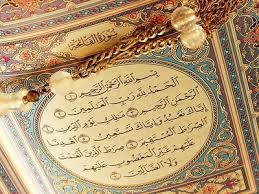
 Introduction
This Surah is named Al-Fathiha, meaning THE OPENING CHAPTER,because it is the first surah in the Quran , in it is a brief introduction to the rest of the Quran. IT has many other names , two of which are,
1) shifa - cure
In the Name of Allah,
the Most Gracious, the Most Merciful.
Virtues of Surah Fathiha
Surah fathiha is one of the
greatest Surahs in the Quran. it has been narrated by Abu Said bin
AL-Mualla (رضى الله عنه): while I was praying in the Masjid, Allah's messenger
(صلى الله عليه وسلم) called me, but I did not respond to him. Later I said : "O
Allah's messenger , I was praying." He said:" Didn't Allah say: Answer Allah ( by obeying Him) and His messenger when he (صلى الله عليه وسلم) calls you."[V:8:24]
He then said to me: " I will teach you a Surah which is the greatest Surah in the Quran , before you leave the Masjid." Then he got hold of
my hand, and when he intended to leave the Masjid, I said to him:" O Rasoolullah, Didn't you say to me, "I will teach you a Surah which is
the greatest Surah in the Quran?" He said :" ALhamdulillahi rabbil
aalameen, Surah Fathiha which is As_Sab Al-Mathani.( The seven
repeatedly recited verses).
SAHIH BUKHARI
SAHIH BUKHARI
Surah
Fathiha is recited in each rakah of every Salah, so it is very
important for us to understand the meaning of this Surah. Infact this
Surah was so special, that it was revealed to the Messenger of Allah
through a special angel. It comes in a hadith in bukhari;
Once
while Jibreel (AS) was seated with Rasoolullah (Sall Allahu ‘alaihi wa
Aalihi wa Sallim), he suddenly heard from above, a sound of (something)
cracking. He lifted his head and said: “This is an angel descending to
the earth and never (before this did he descend but this day.” This
angel greeted and said: “Be pleased with two (sources of) noor (light) which no
other Nabi before you had been given: Fatihatul Kitab(surah fathihah) and the Khawateem
(Closing Two Verses) of Surah Baqarah; you will not recite even one
letter of these without being given a reward for it. Introduction
This Surah is named Al-Fathiha, meaning THE OPENING CHAPTER,because it is the first surah in the Quran , in it is a brief introduction to the rest of the Quran. IT has many other names , two of which are,
1) shifa - cure
Taken from the program
Momz and kidz
Tuesday, March 13, 2012
The Thief
بسم الله الرحمان الرحيم
In the Name of Allah,
the Most Gracious, the Most Merciful.

Nuri was a poor, simple farmer. Some people thought he was an
incompetent loser because he never meddled himself in anybody's
business and wouldn't speak unless he had to.
One day, someone who was previously reputed to be a wise person
stole Nuri's donkey. When he saw that his donkey had gone, Nuri set
out to the market to buy a new donkey.
As he was walking around the market he saw his own donkey there
for sale. He went up to the seller and said :
''This is my donkey. It was stolen from me last week.''
The thief was a man without shame. He replied :
''You're mistaken; I bought this donkey when it was a foal and raised
it myself.''
When Nuri heard this, an idea occurred to him. He covered the donkey's
eyes and said:
''If this is your donkey, then tell me, which is his blind eye?''
The thief hesitated a moment, and then replied :
''His right eye.''
Nuri uncovered the eye and showed the seller that the eye could see
just fine.
''Oh, I'm sorry, I got confused. Of course, it's his left eye.''
''Once again, you are wrong,''said Nuri, opening the left eye.
The other people in the market had gathered around. They realized
that it was really Nuri who was the wise man.
Our prophetصلى الله عليه وسلم cursed those people who steal other
people's belongings :
'' May Allah Almighty curse thieves!''
لَعَنَ اللهُ السَّارِقَ
رواه البجارى
40 Hadiths withstories
by Prof. Dr. M. Yasar Kandemir
In the Name of Allah,
the Most Gracious, the Most Merciful.
Nuri was a poor, simple farmer. Some people thought he was an
incompetent loser because he never meddled himself in anybody's
business and wouldn't speak unless he had to.
One day, someone who was previously reputed to be a wise person
stole Nuri's donkey. When he saw that his donkey had gone, Nuri set
out to the market to buy a new donkey.
As he was walking around the market he saw his own donkey there
for sale. He went up to the seller and said :
''This is my donkey. It was stolen from me last week.''
The thief was a man without shame. He replied :
''You're mistaken; I bought this donkey when it was a foal and raised
it myself.''
When Nuri heard this, an idea occurred to him. He covered the donkey's
eyes and said:
''If this is your donkey, then tell me, which is his blind eye?''
The thief hesitated a moment, and then replied :
''His right eye.''
Nuri uncovered the eye and showed the seller that the eye could see
just fine.
''Oh, I'm sorry, I got confused. Of course, it's his left eye.''
''Once again, you are wrong,''said Nuri, opening the left eye.
The other people in the market had gathered around. They realized
that it was really Nuri who was the wise man.
Our prophetصلى الله عليه وسلم cursed those people who steal other
people's belongings :
'' May Allah Almighty curse thieves!''
لَعَنَ اللهُ السَّارِقَ
رواه البجارى
40 Hadiths withstories
by Prof. Dr. M. Yasar Kandemir
Subscribe to:
Posts (Atom)
